
Tuesday Fellowship on Zoom.
Ephesians 5 v 21 -32 After an introductory chat, we had a lively discussion with regards to these verses. It was thought that the apostle Paul, rather than putting women down, as some think, was actually’ sticking up’ for them by teaching how husbands should love their wives. Husbands need help in ‘loving our wives just as Christ loved the church and gave himself up for her’ We were able to share many stories from our lives where the teaching from this passage had been relevant. A time of prayer for members of the church family and our own families finished an excellent evening.
Family News
- Angus and Sue want to say “Thanks to everyone who was praying for Milo, the Cavapoo Sue’s niece was helping to look after. When we originally mentioned him, he was about to be left with his owner who was emotionally attached to him, but did not have time to attend to his physical needs. Apart from her niece and her partner, the rest of Sue’s family were also very upset.
The Lord appears to have worked in a wonderful way and his owner, although still loving Milo, has come to realise that she can’t look after him on her own because of her job situation. Strangely, she has not given him to Sue’s niece, but to her niece’s parents to look after. This may be another blessing, as it may help Sue’s brother-in-law to cope with early retirement.”
Shapes, Shines, Sharpens
In February, “Inspiring Women” daily readings were about our ‘cutting edge’ as Christians. The writer recalls how her husband sharpens his axe with a whetstone before chopping up logs. In the same way, she says, God’s Word “shapes, shines and sharpens us” to do God’s work.
How are your shape, shininess and sharpness?
A Poem based on Ephesians 6
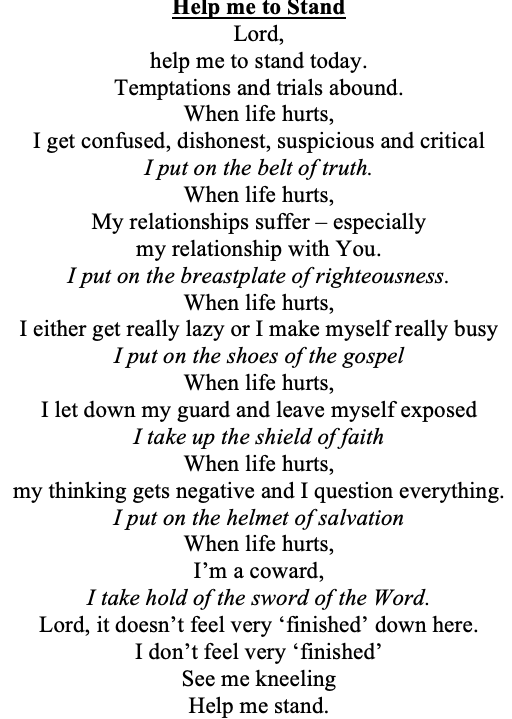
(From ‘God on Mute’ by Pete Greig)
How Covid-19 is changing the way we worship.
Interview with Tim Hughes. (Questions asked by Sam Hailes, Editor of Premier Christianity Magazine)
I think it’s really funny how God works. You set your main theme on worship at a time when so many people think: Worship is about singing songs in church – and we’re not able to do that. We’re locked down and are rethinking ‘what is worship?’ in a really special way.
Obviously, music is a very significant part of worship. But it’s so much more than that, and we’re seeing the Church live out worship so profoundly with things like Love Your Neighbour, which is sending food packages to people in need. The Church isn’t just saying “Jesus is good”; we’re practically demonstrating it.
Do you think church leaders should be encouraging people to stand up and sing, and engage with church services, even though they’re watching a laptop or TV screen? Or should our responses during sung worship look different when we’re at home?
I think that there’s a real encouragement that needs to happen around: “Don’t just sit back and watch.” Y’know, you’re not watching Downton Abbey! This isn’t a chance just to consume.
So, we will often say: “Why don’t you stand?”, to shift people away from sitting back. We predominantly livestream services through YouTube, and we’ll encourage you to put a comment up – a worship or prayer emoji or say what you feel God is saying. We’re connecting in worship through the comments.
Last month, Matt Redman said in his cover story for Premier Christianity that without a sense of God’s holiness in the mix, we can’t even call it ‘worship’. He said we need more songs about the majesty and awesomeness of God. What did you make of it?
Matt and I both grew up through Soul Survivor, and I remember the friendship and the fear were always key parts of that. It’s the awe, and the intimacy. That’s the beautiful mystery of the Christian faith – it’s the only faith where you can know and be loved and cherished by the creator of the heavens and the earth. We’re not killing ourselves to try to please and impress him.
But I do think the Church needs to regain a sense of the otherness, the power, the transcendence of God. When we begin to reclaim holiness in our worship, we begin to regain a sense that our lives need to be biblically based. So many are being shifted by culture and being led by what feels right. Actually no, we are Jesus-centred people; we’ve got to be a Bible-based people. We’ve seen this a lot in our church – repentance. We’re seeing areas where we’ve got casual and apathetic and compromised. Because of this pandemic there’s a real shaking and a sense of: “God, we want to get right with you.”
You’ve edited a new book with Nick Drake, which is entitled Why Worship? (SPCK), and features chapters from lots of different Christian leaders. What were some of their answers to that question?
One of the things that runs through the book is this idea that worship is transformational. To worship is to change.
I finish the book by talking about this radio interview during the Second World War when William Temple, who was the Archbishop of Canterbury, said: “This world can be saved from political chaos and collapse by one thing, and that is the worship of Jesus Christ.”
A people putting Jesus first and living lives that overflow out of the celebration and joy of who he is leads to radical discipleship and holiness, a completely different way of thinking around sexuality and money and care for those in need – all of these different things. That begins to change not only us, but the world around us.
There are so many organisations that do incredible things in terms of social justice, but it’s the Church that actually puts Jesus into that question. It’s amazing to care for your physical needs, but you have eternal needs, and you’ve a deep ache in your heart that can be filled by the person of Jesus Christ.
Some church leaders are despondent at the moment, saying: “We believe God speaks today, but we aren’t hearing much from him. And no one who ministers in the area of prophecy saw Covid coming in the first place.” Have you been wondering what God is up to in all of this?
One hundred per cent. I’m very wary of anyone who feels like they know exactly what’s coming up in the next five years because I think across the board, it’s like a massive reset is taking place. It’s been completely bewildering; it’s affecting everything. Did God send it? I don’t know, but God is using it.
I see a few things happening. I see a humbling. That’s been my posture: “God, more than ever, I just want to live right before you.” The danger is, when you’re in church leadership, you get a bit of momentum, and think: We can do this! Let’s go, let’s build our brand, let’s grow this thing. And then suddenly, ‘bang!’, it’s all levelled. You realise, without God, we’ve got nothing.
And so, what I’ve seen is an incredible returning to prayer. We as a church, as a staff team, pray more than we’ve ever prayed before. And I hear that right across the board. So many leaders I’ve been connected with are just praying, because what else can we do? Now’s not the time to plan these grand, huge things, because, God, we just need to [a1] keep close to you.
What’s going to happen? I don’t know. My sense is we’re going to see God move more powerfully than we’ve ever seen. And we’re going to see more persecution than we’ve ever seen. I think it’s going to be more costly, but more beautiful and glorious. (TO BE CONTINUED)
Why Worship? Insights into the wonder of worship edited by Tim Hughes and Nick Drake with Liza Hoeksma (SPCK) is released next month
Africa’s Silent Genocide
A slow motion and largely ignored war is taking place in Africa’s most populous nation, and time is running out for the world to act, says REV JOHNNIE MOORE. (continued form last week)
The situation in Nigeria is out of control and it cannot be neglected any longer. If nothing is done, no one of any or no faith will be spared the ravages of deluded terrorists who believe that their mission of death is a service to God.
In December, Nigeria received some well- deserved tough love from the United States – its loyal ally. Secretary of State Mike Pompeo made the decision to add the nation to the State Department’s annual list of the world’s most heinous violators of religious freedom. Millions of Americans are asking why the United States is sending £1 bn in taxpayer’s money to a country from which news of atrocities flood their social media feeds. The British government should follow suit with similar warnings to its friend and ally. After all the British taxpayer gives £800,000 a day to Nigeria.
In response, there are many things the Nigerians can do. They can start by calling terrorism by its name, whether perpetrated by Boko Haram, IS or by a small subgroup of radicalised Fulani tribesmen- and that perpetrators of terrorism are prosecuted to the fullest extent of the law. Endemic corruption which provides opportunities for terrorists must be rooted out. The military can start utilising the training it has received from the British and Americans, and the Nigerian government can diversify its leadership which is dominated by Northern Muslims. If nothing is done then we could see a catastrophe beyond comprehension.
A failing Nigerian state would cause the failure of all western Africa. If only 5% of Nigeria’s massive young population is drawn to support terrorism, it would make the Islamist threats radiating from the Middle East seem like child’s play. That, in turn, could create a refugee crisis more acute than the one triggered by the Syrian conflict. The world could find itself managing a dangerous brew of Islamic terrorism, intensified by ethnic distrust, all ripe for exploitation by malign actors like the Iranian regime. The countries surrounding Nigeria are already dealing with similar Islamic insurgencies as it is. The fact is that the present and pitiful condition in the country represents a foreign policy failure by everyone. One of Nigeria’s most influential Christian leaders lamented: ”Yesterday was the best day to act”. One of the countries most influential Imams said virtually the same. They are right. Time is running out.
WHAT SHOULD CHRISTIANS DO?
Christians have a special obligation to our suffering brothers and sisters in Nigeria. We should find ourselves inspired by their faith and should tell their stories in our churches and to our families. These are believers drawn straight from the pages of the New Testament who are very willing to die for their faith.
The word of God tells us that we are to “mourn with those who mourn” (Romans 12:15). It tells us that we are to remember those persecuted as if we were there with them (Hebrews 13:3) and we are to pray that they are “delivered from wicked and evil people.” (2 Thessalonians 3:2) Simply put, we should pray the way we hope someone would pray for us if we were in that situation. We can give generously, the way we hope someone would give to us, and we should be an advocate the way we hope someone would be ours.
JOHNNIE MOORE IS THE CO-AUTHOR, WITH RABBI ABRAHAM COOPER, OF ‘THE NEXT JIHAD: STOP THE CHRISTIAN GENOCIDE IN AFRICA.